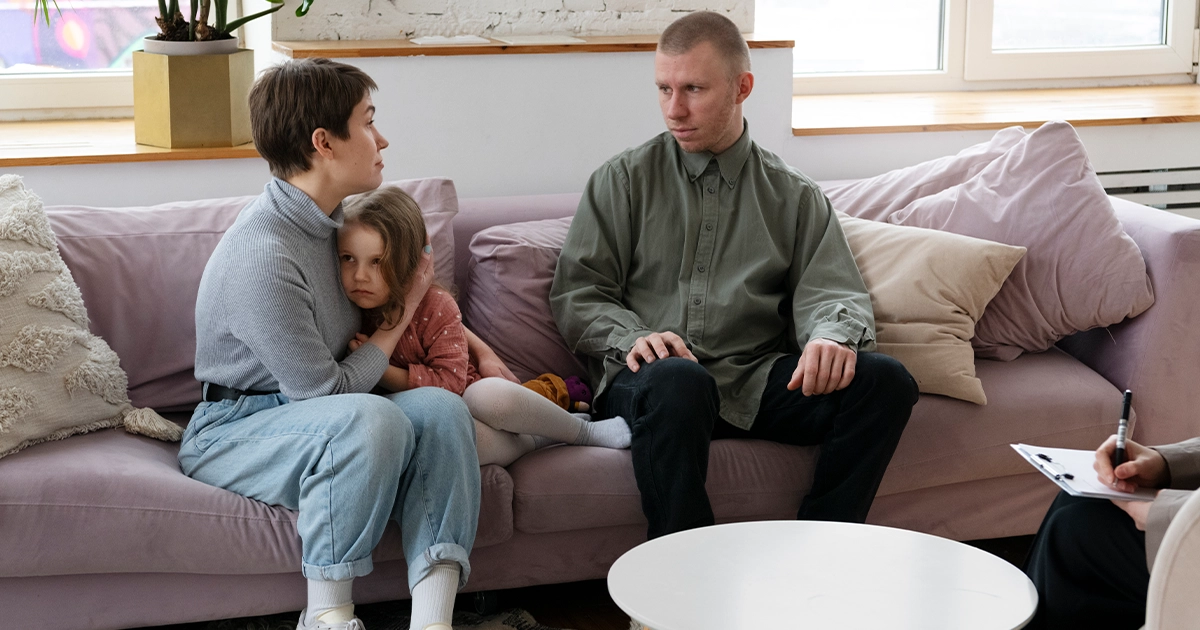
Couples often repeat the same arguments because the surface issue changes less than the interaction pattern underneath it. One partner may push for discussion, criticize, or seek reassurance while the other becomes defensive, withdraws, or shuts down. Each response then influences the next, making the same conflict easier to reactivate even after the original topic seems resolved.
The topic may change, but the emotional ending can feel familiar. One partner leaves feeling ignored, the other criticized, and both believe what mattered was missed.
This does not necessarily mean the relationship is incompatible or that either partner lacks communication skills. It may mean a recurring conflict cycle has become easier to enter than interrupt.
The Canadian Psychological Association notes that conflict is a normal part of close relationships. What matters is how conflict is handled. Patterns involving criticism, blame, withdrawal, and unresolved distress can become increasingly difficult over time.
What Is a Recurring Conflict Cycle?
A recurring conflict cycle is a predictable sequence of reactions between partners.
For example:
- One partner raises a concern.
- The other hears criticism.
- They defend themselves.
- The first partner feels dismissed and becomes more intense.
- The second partner withdraws.
- Both leave the conversation feeling misunderstood.
The topic may start with dishes, finances, intimacy, family boundaries, or phone use. By the end, the argument is often about something larger:
“You do not take me seriously.”
or:
“Nothing I do is ever enough.”
Couples therapy can help partners identify this sequence and respond to the pattern, not only the topic.
Why Does Solving the Practical Problem Sometimes Fail?
A practical solution can help without fully resolving the relationship meaning attached to the issue. A couple may divide household tasks more clearly, improve briefly, and then find the conflict returning.
For one partner, the issue may have become:
“I feel alone carrying this.”
For the other, repeated criticism may have come to mean:
“I cannot get anything right.”
Unless those experiences are addressed, another practical problem can activate the same sequence. This is why recurring arguments are not always solved by another schedule or agreement alone.
What Is the Demand-Withdraw Pattern?
One well-studied conflict pattern is demand-withdraw.
In this cycle, one partner pushes for discussion, change, or resolution while the other avoids, disengages, or withdraws.
The more one person demands engagement, the more the other may pull away, which can intensify the first person’s pursuit.
The pattern can occur in either direction and is not a fixed gender role.
A recent Canadian-led observational study involving 151 couples examined demand-withdraw behaviour during sexual conflict. Higher demand-withdraw was associated with lower relationship satisfaction at the time of the study and lower relationship satisfaction one year later. The study does not prove that the pattern alone causes relationship decline, but it adds to evidence that repetitive demand-withdraw interactions are clinically meaningful. Read the study.
If this pattern is central in your relationship, see our guide to when one partner shuts down and the other pursues.
What Other Conflict Patterns Can Repeat?
Recurring arguments do not always follow demand-withdraw.
Other patterns may include:
Criticize and Defend
One partner raises the issue through accusation and the other defends or counterattacks. Both may end up protecting themselves instead of addressing the concern.
If blame and defensiveness are the main issue, our article on breaking the blame cycle explores that pattern separately.
Fix and Feel Unheard
One partner shares distress while the other offers solutions. The first wanted empathy; the second believed they were helping.
Escalate and Shut Down
One person becomes more intense to seek engagement while the other becomes quieter because the intensity feels overwhelming. Each reaction can reinforce the other.
Why Do Small Problems Turn Into Big Arguments?
A disagreement can carry meaning from earlier relationship experiences.
A missed text may mean:
“I am not a priority.”
A spending decision may mean:
“I cannot rely on us to make financial decisions together.”
A change of plans may mean:
“My preferences do not matter.”
This does not mean every disagreement is about childhood, trauma, or attachment. The meaning attached to an event can simply matter more than the event itself.
Couples therapy can help partners distinguish between:
What happened?
and:
What did what happened mean to me?
That difference can make the conflict easier to understand.
Are Repeating Arguments Always a Communication Problem?
No.
Communication matters, but many couples already know basic communication advice.
They may know to:
- listen
- avoid interrupting
- use “I” statements
- stay respectful
- take breaks
The difficulty is using those skills when someone feels rejected, criticized, dismissed, or overwhelmed.
A 2025 review of 48 quantitative couple-therapy process studies found no single, well-replicated explanation for exactly how couple therapy produces change. That supports a cautious approach to claims about any one technique or model. Read the review.
Experienced couples therapy therefore considers communication skills, interaction patterns, emotional meaning, accountability, stress, and context.
How Can Couples Therapy Help Stop Repeating Arguments?
Couples therapy can help by slowing the argument down enough to study what happens before, during, and after it.
1. Map the sequence
A therapist may help reconstruct a recent conflict:
- What happened first?
- What did each person think it meant?
- What emotion came up?
- How did each person respond?
- What happened next?
The goal is to make the cycle easier to recognize.
2. Identify early warning signs
Partners may notice:
- tone becoming sharper
- interrupting
- preparing a defence instead of listening
- physical tension
- feeling the urge to leave
- using “always” or “never”
- bringing unrelated past conflicts into the current discussion
Recognizing these signs earlier creates more opportunity to respond differently.
3. Change one part of the cycle
The entire pattern does not need to change in one conversation.
If criticism is the usual response:
“You never listen.”
might become:
“I feel dismissed when I have not finished speaking.”
If withdrawal is the usual response:
“I am done.”
might become:
“I am getting overwhelmed. I want to continue, but I need a break first.”
A different response does not guarantee a different reaction, but it interrupts the usual move.
4. Separate validation from agreement
Understanding a partner’s emotional experience does not require agreeing with every interpretation.
A person can say:
“I understand why that felt disappointing.”
without saying:
“Everything you believe about what happened is correct.”
That distinction can reduce the pressure to defend every detail before the emotional impact has been heard.
5. Repair after conflict
Some couples stop arguing, return to normal tasks, and never revisit what happened.
Repair may involve:
- acknowledging impact
- taking responsibility
- clarifying a misunderstanding
- apologizing specifically
- discussing what needs to change
- following through on an agreement
If resentment has accumulated after repeated unrepaired conflict, see our guide to couples therapy for resentment.
Do Healthy Couples Still Repeat Some Arguments?
Yes.
Not every disagreement can or should be permanently eliminated.
Couples can have lasting differences around:
- money
- family
- organization
- social life
- parenting
- intimacy
- household standards
- how much time to spend together
Progress may mean the issue remains but the process changes. You may notice less escalation, shorter recovery time, fewer global accusations, more direct requests, less withdrawal, and better follow-through.
The goal is not zero conflict, but a workable way of handling it.
What If Outside Stress Is Driving the Arguments?
Sometimes the relationship is not the only source of the problem.
Work pressure, parenting, caregiving, finances, health concerns, lack of sleep, immigration stress, or extended-family responsibilities can reduce the capacity partners have available for one another.
If conflict tends to increase during demanding periods, our article on outside stress and couples may be useful.
Therapy can help distinguish relationship patterns from outside pressure.
What Does Emotionally Focused Therapy Add?
Madelin Donovan, Registered Psychotherapist, is Nurturing Wellness’ couples therapy specialist and has completed an Emotionally Focused Therapy (EFT) Externship.
EFT focuses on the interaction cycle between partners and the emotions and attachment-related concerns that may sit underneath recurring conflict.
The therapist may explore what happens when one partner pulls away, what criticism means to the other, what each person is protecting, and which needs are difficult to express directly.
The purpose is to make the cycle clearer while preserving accountability for individual behaviour.
When Should Couples Consider Therapy for Repeating Arguments?
Therapy may be worth considering when:
- the same conflict keeps returning
- conversations become increasingly reactive
- one partner avoids difficult topics
- resentment is growing
- repair is becoming harder
- both partners know the advice but cannot use it during conflict
- emotional distance is increasing
- arguments are affecting intimacy, parenting, or daily life
Couples therapy may help before the pattern becomes harder to interrupt.
When Couples Therapy May Not Be the Right First Step
Not every difficult relationship should be framed as two people equally contributing to a cycle.
If there is violence, coercive control, intimidation, threats, or fear of retaliation, standard conjoint couples therapy may not be the safest starting point.
Safety concerns should be discussed privately with a clinician. Individual support, safety planning, or specialized intimate-partner-violence services may be more appropriate.
If you are in immediate danger, call 9-1-1.
Couples Therapy at Nurturing Wellness
Nurturing Wellness offers couples therapy in Mississauga for partners experiencing recurring arguments, communication difficulties, emotional distance, resentment, trust concerns, parenting stress, and other relationship challenges.
Couples therapy is available in person in Mississauga and online across Ontario, which can help with work, parenting, travel, or scheduling demands.
You can also learn more about online therapy at Nurturing Wellness.
Book a free 15-minute consultation to discuss whether couples therapy may be a suitable next step.
Visit Nurturing Wellness in Mississauga
Nurturing Wellness offers in-person therapy at 1420 Burnhamthorpe Road East, Suite 310, Mississauga, ON L4X 2Z9.
Frequently Asked Questions
Couples often repeat arguments because the underlying interaction pattern remains unchanged even when the practical issue appears resolved. Criticism, defensiveness, pursuit, withdrawal, feeling unheard, or unresolved hurt can reactivate the same cycle around different topics.
Demand-withdraw occurs when one partner pushes for discussion, change, or resolution while the other disengages or withdraws. Either partner can take either role depending on the issue and the relationship context.
Couples therapy can help partners identify the conflict cycle, understand what triggers it, practise different responses, and improve repair. It cannot guarantee that disagreements will disappear.
A structured break can be useful when the conversation has become too reactive to continue productively. It helps to communicate that you intend to return to the issue and agree on when the conversation will resume.
There is no reliable fixed timeline. Progress depends on the concerns involved, how long the pattern has existed, participation, relationship safety, outside stress, therapist fit, and the treatment approach.
Yes. Nurturing Wellness offers online couples therapy across Ontario as well as in-person sessions in Mississauga. Suitability depends on privacy, safety, each partner’s ability to participate, and clinical assessment.